
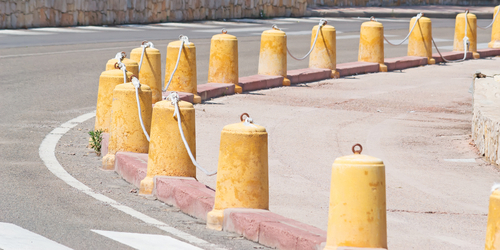
Most properties that lack safety bollards present a passive yet serious risk through a design oversight that leaves pedestrians exposed if a nearby vehicle loses control. Drive-thru restaurants and coffee shops are a bit different. When a chain builds a drive-thru lane that runs alongside the same sidewalks, entrance doors, and outdoor waiting areas where its on-foot customers stand, it is making an active design decision to bring vehicles and pedestrians into direct proximity. Safety bollards, or reinforced steel posts anchored in concrete that stop an errant vehicle before it reaches the people nearby, are the standard solution to that risk. When they are absent at these locations, the danger is practically engineered into the design.
A Design That Creates Built-In Hazards
Typically, a drive-thru will place two groups of customers in the same small space at the same time: those in vehicles and those on foot. The business benefits from serving both simultaneously. The risk that arrangement creates, involving a vehicle reaching pedestrians with no physical barrier in the way, is a foreseeable consequence of that layout, and the volume of customers cycling through these spaces throughout the day and late into the night only raises the stakes.
Risk Factors Unique to the Drive-Thru Setting
Drivers in a drive-thru lane are often distracted while their vehicle is positioned closest to pedestrian areas. They might be navigating a menu board, placing an order through a speaker, managing a phone or payment app, or receiving food through a window instead of paying attention to the people around them. A momentary brake-to-gas error or a misjudgment of lane position can send a vehicle directly into a sidewalk full of customers with no warning.
Late-night operations compound that risk considerably. Many fast-food chains deliberately remain open past midnight, with some open even until 3:00 or 4:00 a.m., especially near bar districts and college campuses because post-bar foot traffic is profitable. Choosing to operate a drive-thru to attract a late-night crowd, including potentially impaired drivers, into a space where other customers on foot are standing feet from the lane is not a passive failure to anticipate danger. It is an active business choice that creates one.
Coffee shop drive-thrus carry their own risk profile, too. Often built into tight spaces where the lane runs close to the front entrance, these locations tend to see concentrated, rapid pedestrian traffic during morning peak hours. A large share of the daily customer volume passes through the same small zone on foot and in vehicles, and in a very short window of time, leaving almost no margin for driver error.
When Restaurants Protect Equipment But Not People
One of the most revealing patterns in drive-thru vehicle intrusion accidents is that many chain locations already have bollards, just not where customers walk. Crash-rated barriers protecting outdoor equipment, trash enclosures, or building corners are common at locations that leave pedestrian areas entirely unprotected. When a property owner has already installed bollards to protect its own assets and chosen not to extend that same protection to the people on its premises, the argument that the risk was unforeseeable or that bollards were not a practical option can be difficult to uphold, especially under the pressure of a talented premises liability attorney. That pattern of selective installation is the kind of evidence that carries significant weight in a premises liability case, after all.
This is not hypothetical, either. In Vijay v. Raising Cane's Restaurants, LLC, a case handled by Howry Breen & Herman, LLP, a 21-year-old university student suffered a traumatic brain injury when a vehicle came onto the pedestrian sidewalk at a Raising Cane's drive-thru location. Bollards were already present at the same property, protecting the restaurant's equipment. Yet the pedestrian area was left entirely unprotected. (The case is in litigation in Travis County, Texas, at the time of this writing.)
A Property Owner's Responsibility
Under premises liability law, commercial property owners, including large restaurant and coffee chains, are responsible for maintaining reasonably safe conditions for everyone on their premises. When a drive-thru operator has the knowledge, the resources, and prior examples of bollard use on its own properties, and still leaves pedestrian areas unprotected, a vehicle intrusion accident may support a legal claim not just against the driver but against the property owner as well.
Were You Injured at a Drive-Thru or Restaurant Property?
If you or a loved one was seriously injured when a vehicle entered a restaurant's pedestrian area, you may have a claim against the property owner in addition to the driver. At Howry Breen & Herman, LLP, we have been handling catastrophic injury and premises liability cases in Texas for years, and we use a contingency fee basis that means you pay nothing unless we win, so it is simple to talk to us and learn more about your options.
Call (512) 430-4844 and ask for a free consultation today.